Robotics
Introduction to Marine Robotics
The LEGO EV3 control brick (EV3 brick) contains batteries, a microcontroller, input buttons and a screen. LEGO originally made a block coding system to program it, but this has been discontinued. Also, your teacher is not a fan of block coding. A non-profit organisation called Pybricks has created a system where the EV3 brick can now be programmed using MicroPython instead. This is a streamlined version of the usual Python language. It has been installed via SD cards onto the EV3 brick. The coding is done via a common editor known as Visual Studio Code.
Module 1 – Design Challenge
Course: Build an Underwater ROV While Learning Physics
Suggested Duration: 2–3 hours (self-paced) or 2 × 75-minute class periods
Level: College Physics / AP Physics 1 entry point (scalable upward)
Learning Objectives
By the end of this module, students will be able to:
- Explain what an ROV is and describe its real-world applications in ocean science and industry
- Identify the key subsystems of an underwater ROV (frame, propulsion, power, control, sensors)
- Apply the engineering design process to propose an initial ROV design
- Draw and analyse a free body diagram for a submerged object
- Identify the forces acting on an ROV during hover, ascent, and descent
📖 Section 1: What Is an ROV?
1.1 Definition & Overview
- ROV = Remotely Operated Vehicle
- Uncrewed, tethered, operated from the surface
- Distinction between ROVs, AUVs (Autonomous Underwater Vehicles), and crewed submersibles
1.2 Real-World Examples
- NOAA: Deep-sea exploration, seafloor mapping, shipwreck documentation
- BIOS (Bermuda Institute of Ocean Sciences): Local research deployments — coral reef monitoring, water column sampling
- Industry: Oil & gas pipeline inspection, offshore wind farm maintenance, cable laying
- Search & Rescue: Locating the Titanic (Alvin/Jason Jr.), MH370 search
- Military: Mine detection and disposal
1.3 The Bermuda Connection
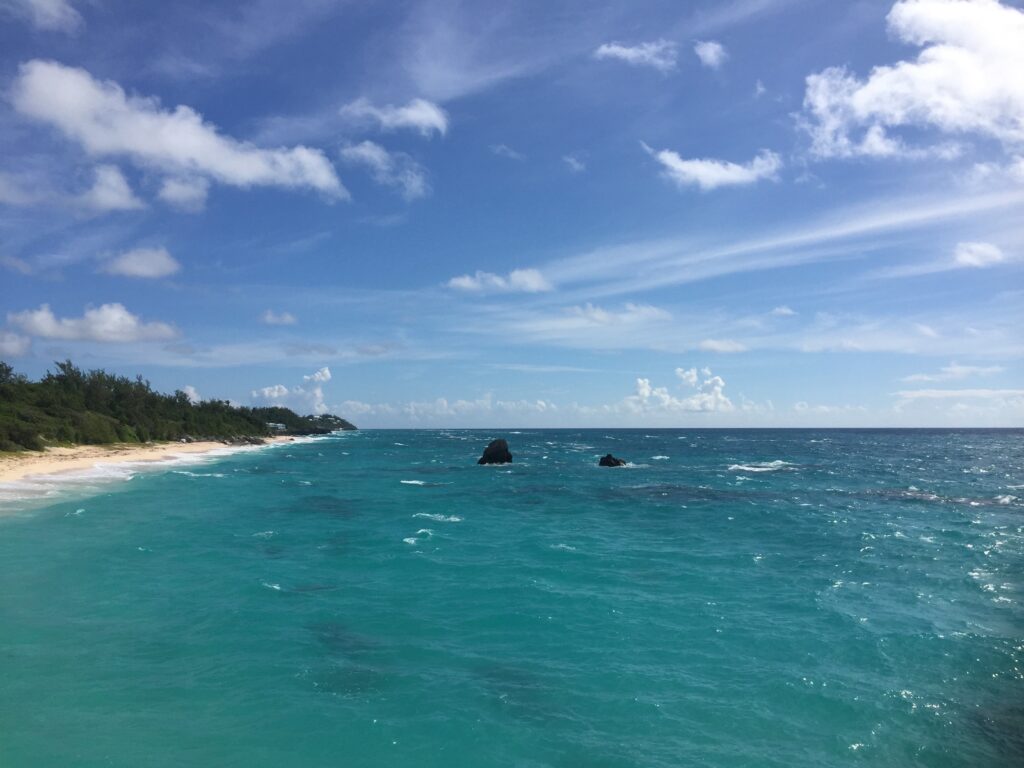
- Bermuda’s unique position: isolated seamount in the North Atlantic, surrounded by deep water (>4,000 m within 50 km)
- Local ROV use cases: coral reef surveys, shipwreck exploration (Bermuda has 300+ documented wrecks), invasive lionfish monitoring
- BIOS partnership opportunity: link to real Bermuda ocean data and research
- Discussion prompt: “If you could deploy an ROV anywhere around Bermuda, where would you go and what would you look for?”
🔧 Section 2: Anatomy of an ROV
2.1 Key Subsystems
| Subsystem | Function | Physics Connection |
| Frame & Hull | Structural support, buoyancy control | Archimedes’ Principle, density |
| Propulsion | Movement in 3D space | Newton’s 3rd Law, fluid dynamics |
| Power System | Electrical energy supply | DC circuits, power, energy |
| Control System | Pilot input → motor response | Electromagnetism, signal transmission |
| Sensors & Cameras | Data collection, navigation | Optics, pressure, temperature |
| Tether | Power and signal transmission | Resistance, signal attenuation |
2.2 ROV Size Classes
- Micro/Mini: Educational builds (e.g., OpenROV, Blue Robotics) — what we will build
- Work-class: Industrial ROVs (e.g., Schilling Robotics UHD) — up to 3,000 kg
- Trenching/burial: Massive cable-laying systems
2.3 Our Build Target
- PVC-frame ROV with 3–4 thrusters
- Arduino-based control system
- Waterproofed camera
- Operating depth: 0–5 m (pool/shallow water testing)
- Estimated cost: \$150–\$400 depending on components
⚙️ Section 3: The Engineering Design Process
3.1 Overview of the Process
- Define the problem and constraints
- Research existing solutions
- Brainstorm design ideas
- Prototype and build
- Test and evaluate
- Iterate — redesign based on results
3.2 Design Constraints for This Project
- Budget limit (set by teacher/student)
- Must be neutrally buoyant at operating depth
- Must be controllable via tether from surface
- Must survive submersion to at least 2 m
- Must complete at least one defined underwater task (e.g., retrieve an object, photograph a target)
3.3 Design Challenge Activity
Task: Before building anything, sketch your initial ROV design.
- Label all subsystems
- Indicate where you think the centre of mass and centre of buoyancy will be
- Justify your thruster placement — how will you achieve movement in each direction?
- Identify your three biggest design uncertainties
Format: Hand-drawn sketch + short written justification (1 paragraph per subsystem)
⚡ Section 4: Physics Foundation — Forces on a Submerged Object
4.1 The Four Key Forces
- Weight W=mg — acts downward through the centre of mass
- Buoyant Force Fb=fluidVdisplacedg — acts upward through the centre of buoyancy
- Thrust FT — provided by propellers, direction depends on thruster orientation
- Drag FD=12CDAv2 — opposes motion, depends on shape and speed
4.2 Free Body Diagrams
- Hovering (neutral buoyancy): Fb=W, no vertical thrust needed
- Ascending: Fb+FTup>W+FDdown
- Descending: W+FTdown>Fb+FDup
- Moving horizontally: horizontal thrust must overcome horizontal drag
4.3 Why Neutral Buoyancy Matters
- If Fb=W, the ROV hovers without using thruster power for depth control
- Conserves battery life
- Allows precise depth holding
- Design implication: Frame material, electronics housing, and ballast must be carefully chosen and balanced
4.4 Worked Example
An ROV has a mass of 2.4 kg. Its frame displaces 2.8 litres of seawater (=1025 kg/m3).
- Calculate the weight of the ROV.
- Calculate the buoyant force.
- Is the ROV positively, negatively, or neutrally buoyant?
- How much ballast mass would you need to add to achieve neutral buoyancy?
✅ Section 5: Self-Check Quiz
- What is the difference between an ROV and an AUV?
- Name three real-world applications of ROVs.
- List the six subsystems of an ROV and the physics concept associated with each.
- A submerged object has weight 15 N and buoyant force 18 N. What is the net force and in which direction does it act?
- Why is neutral buoyancy desirable in an ROV design?
🔬 Section 6: Lab Activity — Buoyancy Exploration
Purpose
To experimentally verify Archimedes’ Principle and explore how material choice affects buoyancy.
Materials
- Spring scale or digital balance
- Overflow container or graduated cylinder
- Water tank or large bucket
- Various objects (PVC pipe, foam, metal rod, plastic bottle)
- String
Procedure
- Measure the weight of each object in air.
- Submerge each object and measure the apparent weight using the spring scale.
- Collect the displaced water and measure its volume.
- Calculate the buoyant force two ways: (a) Fb=Wair−Wwater and (b) Fb=waterVdisplacedg
- Compare results and calculate percentage difference.
Analysis Questions
- Do your two methods agree? What sources of error might explain any discrepancy?
- Which material would make the best ROV frame? Justify using your data.
- How would your results change in seawater vs. freshwater?
💬 Section 7: Reflection & Discussion
- “What surprised you most about how ROVs work?”
- “Which subsystem do you think will be the most challenging to build? Why?”
- “How does the physics of buoyancy constrain your design choices before you even pick up a tool?”
- “If you were designing an ROV for Bermuda’s deep water (1,000 m+), how would your design need to change?”
➡️ Coming Up: Module 2 — Buoyancy & Ballast
In Module 2, we go deeper (literally) into Archimedes’ Principle, pressure at depth, and the practical challenge of achieving and maintaining neutral buoyancy as your ROV takes shape.